
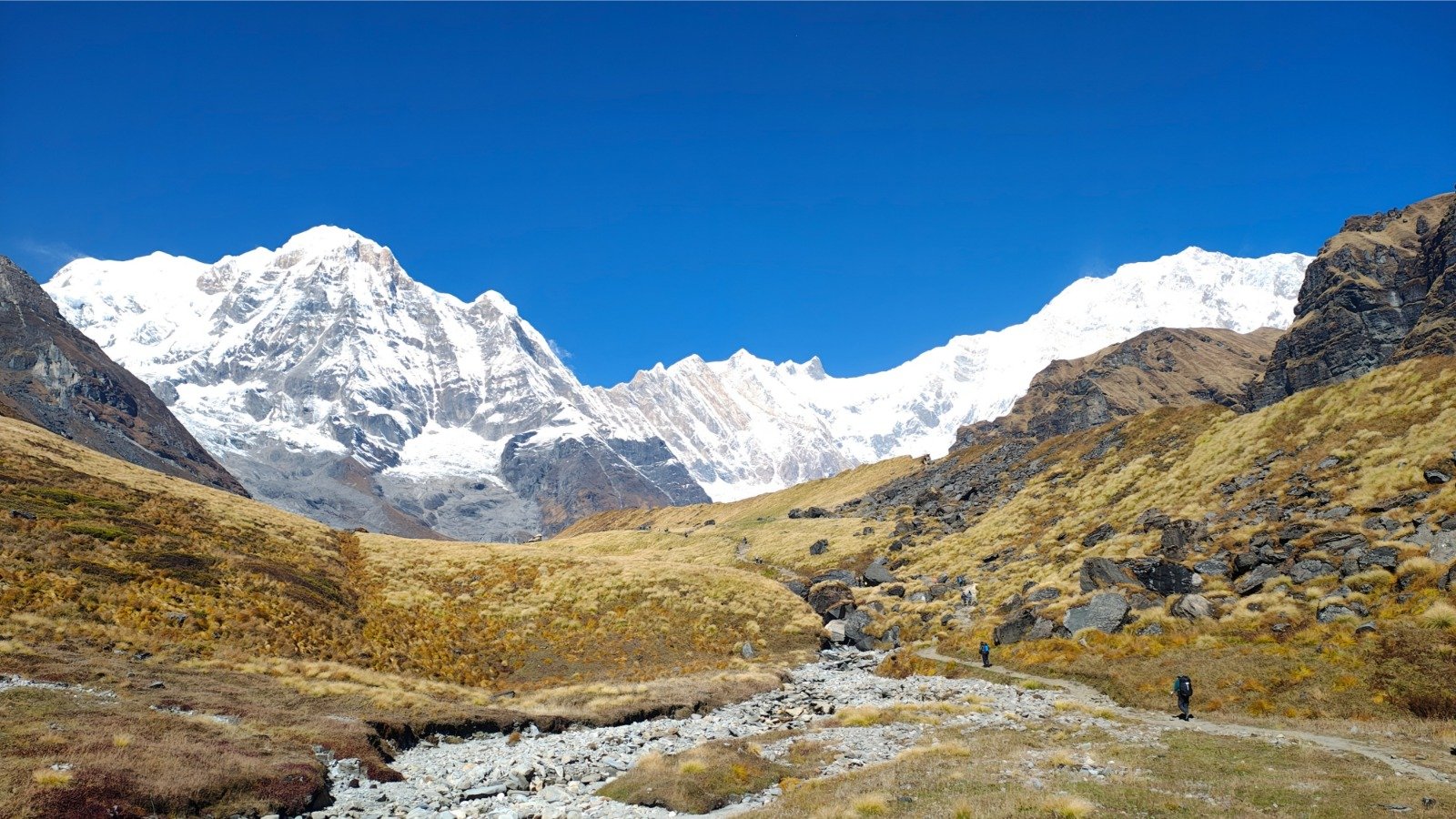


The Annapurna Base Camp Ghandruk Circuit Trek is one of the most immersive and emotionally powerful trekking experiences in the Himalayas. This trek is not just about reaching a destination; it is about walking deep into the heart of the Annapurna Sanctuary, understanding the rhythm of mountain life, and standing face to face with one of the world’s most formidable peaks — Mt. Annapurna I (8,091 m).
Starting from Pokhara, the trek follows the culturally rich Ghandruk Circuit route, a trail that blends traditional mountain villages, dense forests, alpine landscapes, and towering Himalayan peaks into one continuous journey. Unlike rushed trekking routes, the Annapurna Base Camp Ghandruk Circuit Trek allows the body and mind to adapt gradually, making the experience deeper, safer, and far more rewarding.
This trek is designed for trekkers who want more than photographs — for those who want a true Himalayan experience.
Why the Annapurna Base Camp Ghandruk Circuit Trek Is One of the World’s Greatest Treks
What makes the Annapurna Base Camp Ghandruk Circuit Trek truly extraordinary is the fact that it brings you incredibly close to an eight-thousand-meter mountain without requiring technical climbing skills. Very few trekking routes on Earth allow non-mountaineers to experience the scale, power, and presence of a mountain like Annapurna I, the tenth-highest peak in the world.
The Annapurna Base Camp Trek is often called “the closest you can get to Annapurna without climbing it”. Standing inside the natural amphitheater of the Annapurna Sanctuary, surrounded by Annapurna South, Annapurna III, Gangapurna, Hiunchuli, Machhapuchhare, and more, is an experience that permanently changes how you see mountains — and yourself.
The Ghandruk Circuit Trek route adds cultural depth to this experience, making the journey as meaningful as the destination.
Why the Ghandruk Circuit Route Changes Everything
Most people talk about reaching Annapurna Base Camp. Very few understand that how you reach it defines the experience. The Ghandruk Circuit route is what separates this trek from the ordinary.
Starting from Pokhara, the trail enters the mountains through Ghandruk village—one of the most culturally rich villages in the Annapurna region. Instead of rushing into altitude, the Ghandruk Circuit allows your body and mind to transition naturally.
This gradual ascent is not just safer—it is deeper. You don’t merely pass through the mountains; you settle into them.
Why Annapurna Base Camp Ghandruk Circuit Trek Is a Must-Do Himalayan Trek
The Annapurna Base Camp Ghandruk Circuit Trek stands out because it brings trekkers face to face with Mt. Annapurna I (8,091 m) without the risks associated with high-altitude climbing.
From the moment you leave Pokhara, the trail unfolds a continuous transformation of landscapes—from terraced farmlands and forested hillsides to dramatic alpine terrain. The Ghandruk Circuit route ensures better acclimatization, making the experience safer and more enjoyable.
Starting Point: Pokhara – Gateway to the Annapurna Region
Pokhara serves as the starting point for the Annapurna Base Camp Ghandruk Circuit Trek. Nestled beside Phewa Lake and surrounded by Himalayan ranges, Pokhara is one of Nepal’s most beautiful trekking hubs.
Ghandruk Village – Cultural Foundation of the Trek
Ghandruk village, located at around 2,013 meters, is one of the most culturally significant villages on the Annapurna Base Camp Trek. Home to the Gurung community, it offers authentic Himalayan culture and hospitality.
Annapurna Base Camp – Inside a Himalayan Amphitheater
At 4,130 meters, Annapurna Base Camp places you inside a colossal ring of mountains—Annapurna I, Annapurna South, Annapurna III, Gangapurna, Hiunchuli, and Machhapuchhare.
Why Choose Himalayan Hikers for the Annapurna Base Camp Trek
Himalayan Hikers specializes in safe, responsible, and well-planned high-altitude trekking experiences. Our experienced guides, b local networks, and focus on acclimatization and safety ensure a smooth and memorable journey.
Annapurna Basecamp Ghandruk Circuit Trek Complete Guide
Our mission has always been to ensure that no trekker steps into the Himalayas without the right perspective. A trek is not just a checklist of summits; it is a serious commitment to the outdoors. Having the right information is what separates a reckless climb from a soulful journey.
This section serves as your definitive manual for the Annapurna Basecamp Ghandruk Circuit Trek . We have distilled years of mountain experience and real-time feedback into this guide to give you a clear, honest picture of the trail.
We provide this depth of information because we want you to be more than just a visitor—we want you to be a prepared, responsible trekker who respects the mountains as much as we do.
Day 1: Team meet at Pokhra. Stay in Hotel.
Day 2: Pokhra - Ghandruk Bus stand.
Drive duration: 4 hours | Drive: 65 km | Same Day: Trek to Ghandruk village. Altitude: 2,013 m | Trek duration: - ½ hours | Trek 1 km. Stay in Tea House.
Day 3: Ghandruk Village - Chomrong.
Altitude: 2,170 m | Trek Duration: 7 hours | Trek: 9.5 km. Stay in Tea House.
Day 4: Chomrong - Dovan.
Altitude: 2,600 m | Trek duration: 6 hours | Trek: 9 km. Stay in Tea House.
Day 5: Dovan - Machchapuchare Basecamp.
Altitude: 3,700 m | Trek duration: 6 hours | Trek: 9 km. Stay in Tea House.
Day 6: Machchapuchare Basecamp - Annapurna Basecamp.
Altitude: 4,130 m | Trek duration: 2 hours | Trek: 3 km. Stay in Tea House.
Day 7: Annapurna Basecamp - Bamboo Village.
Altitude: 2,310 m | Trek Duration: 9 hours | Trek: 14 km Stay in Tea House.
Day 8: Bamboo Village – Chomrong.
Altitude: 2,170 m | Trek: 7 km. Stay in Tea House.
Day 9: Chomrong – Jhinu Danda.
Altitude: 1,780 m | Trek duration: 1.5 hours | Trek: 3 km. Then Drive up to Pokhara | Drive duration: 4 hours | Drive: 60 km
Day 1
Day 2
Day 3
Day 4
Day 5
Day 6
Day 7
Day 8
Day 9
Day 1: Arrival & Team Meet at Pokhara
Key Highlights of Day 1
- Arrival at Pokhara, the gateway to the Annapurna region
- Team meet and introduction with Himalayan Hikers trek leader
- Detailed trek briefing and itinerary overview
- Gear check and final trek preparation
- Relaxed acclimatization day before entering the mountains
- Overnight stay in a comfortable hotel at Pokhara
Day 1 of the Annapurna Base Camp Ghandruk Circuit Trek begins with your arrival at Pokhara, one of the most scenic cities in Nepal and the official gateway to the Annapurna Himalayas. Located beside the serene Phewa Lake and surrounded by lush hills and snow-capped peaks, Pokhara sets the perfect tone for the journey ahead.
Trekkers reach Pokhara either by road or by a short domestic flight from Kathmandu. As you arrive, the atmosphere immediately feels calmer and more relaxed compared to the capital city. The fresh mountain air, peaceful surroundings, and distant Himalayan views signal the beginning of an unforgettable trekking experience.
Once all participants have arrived, the team meet is organized by Himalayan Hikers. This session is an essential part of the trek and allows trekkers to meet their trek leader, guides, and fellow group members. Introductions help build comfort, trust, and group bonding—an important element for a high-altitude Himalayan trek.
During the team meet, the trek leader conducts a detailed briefing covering the entire Annapurna Base Camp Ghandruk Circuit Trek itinerary. Each trekking day is explained clearly, including daily distances, altitude gain, walking hours, terrain type, and expected weather conditions. This briefing ensures that trekkers understand what to expect physically and mentally during the trek.
A comprehensive gear check is also carried out on Day 1. The trek leader reviews essential equipment such as trekking shoes, backpacks, jackets, thermal layers, gloves, and personal gear. If any item is missing or unsuitable, trekkers are advised to arrange or rent equipment in Pokhara itself. This step plays a crucial role in maintaining safety and comfort during the trek.
Since the Annapurna Base Camp Ghandruk Circuit Trek reaches an altitude of 4,130 meters, acclimatization and preparation are extremely important. Day 1 serves as a gentle transition phase—allowing trekkers to rest, hydrate well, and mentally prepare before moving into the mountains. Trekkers are encouraged to avoid heavy physical activity and focus on relaxation.
The remainder of the day is free for trekkers to explore Pokhara at their own pace. You may take a short walk along Phewa Lake, enjoy views of the surrounding hills, or simply rest at the hotel. This downtime helps your body recover from travel fatigue and prepares you for the trekking days ahead.
In the evening, trekkers gather for dinner, which marks the official start of the trekking journey. This shared meal offers an opportunity to connect with fellow trekkers and discuss the adventure that lies ahead. The excitement builds as everyone prepares to leave behind city life and enter the heart of the Himalayas the next morning.
The night is spent in a comfortable hotel in Pokhara, ensuring proper rest before the journey continues toward Ghandruk on Day 2. A good night’s sleep on Day 1 is essential, as the following days involve long trekking hours and gradual altitude gain.
Day 1 is not just an arrival day; it is the foundation of the entire trek. Proper briefing, preparation, and rest on this day significantly enhance safety, confidence, and overall trekking experience. Himalayan Hikers ensures that every trekker starts the journey informed, prepared, and motivated.
Day 2: Pokhara – Ghandruk Bus Stand | Trek to Ghandruk Village
Key Highlights of Day 2
- Scenic drive from Pokhara to Ghandruk Bus Stand
- First trekking day of the Annapurna Base Camp Ghandruk Circuit Trek
- Walk through terraced farmlands and forest trails
- Arrival at the traditional Ghandruk village
- First night stay in a tea house
- Stunning views of Annapurna South, Hiunchuli and Machhapuchhare
Day 2 marks the true beginning of the Annapurna Base Camp Ghandruk Circuit Trek. After an early breakfast in Pokhara, the team prepares for a scenic mountain drive toward the Ghandruk Bus Stand. This drive takes approximately 4 hours and covers a distance of about 65 kilometers, gradually moving away from city life into the foothills of the Annapurna region.
As the vehicle leaves Pokhara behind, the landscape begins to change dramatically. Smooth city roads give way to winding mountain roads, rivers flow alongside the route, and terraced fields appear on the hillsides. Small villages, suspension bridges, and lush green valleys provide a glimpse into rural Nepali life. This drive itself feels like a transition—from comfort into adventure.
Upon reaching the Ghandruk Bus Stand, trekkers take a short break to stretch, hydrate, and prepare for the first walk of the journey. This is where backpacks are adjusted, trekking shoes tightened, and excitement begins to build. From here, the trail officially starts toward Ghandruk village.
The trek to Ghandruk village is short yet incredibly scenic, covering a distance of about 1 kilometer and taking roughly 30 minutes. Though the walk is relatively easy, it serves as an important introduction to the terrain and rhythm of Himalayan trekking. The trail passes through stone-paved paths, terraced farmlands, and forested sections, offering immediate immersion into the mountain environment.
As you ascend toward Ghandruk, the views begin to open up. Snow-capped peaks start appearing in the distance, and the cool mountain air feels refreshing. This section allows trekkers to walk at a relaxed pace, helping the body slowly adjust to the altitude of 2,013 meters.
Ghandruk village is one of the most beautiful and culturally rich villages in the Annapurna region. Known for its traditional stone houses, narrow alleys, and warm hospitality, Ghandruk offers trekkers their first authentic Himalayan village experience. The village is home to the Gurung community, whose lifestyle and traditions are deeply connected to the mountains.
Upon arrival, trekkers check into a local tea house. This marks the first tea house stay of the trek and introduces trekkers to the simple yet comforting mountain accommodation style. Rooms are basic but clean, and the atmosphere is warm and welcoming. After freshening up, trekkers usually gather in the common dining area.
One of the highlights of Day 2 is the breathtaking mountain scenery visible directly from Ghandruk village. On a clear day, trekkers are rewarded with stunning views of Annapurna South, Hiunchuli, and the iconic Machhapuchhare (Fishtail Peak). Watching these peaks glow during sunset is often an unforgettable moment for many trekkers.
The evening is generally relaxed, allowing trekkers to explore the village, interact with locals, and observe traditional village life. You may see locals tending to fields, children playing in the courtyards, and prayer flags fluttering in the mountain breeze. This cultural immersion adds depth and meaning to the trek.
Dinner is served at the tea house, usually consisting of warm, freshly prepared Nepali meals. Sharing a meal with fellow trekkers creates a sense of camaraderie and marks the transition from individual travelers into a trekking group. Conversations often revolve around the journey ahead, mountain views, and shared excitement.
The night is spent in the tea house at Ghandruk. Sleeping at this altitude helps the body begin the acclimatization process naturally. Trekkers are advised to stay hydrated, avoid alcohol, and get adequate rest, as the following days involve longer trekking hours and increased altitude gain.
Day 2 plays a crucial role in setting the tone for the entire trek. It introduces trekkers to mountain travel, village life, tea house culture, and the grandeur of the Annapurna range. The combination of a scenic drive, gentle trek, and cultural exposure makes this day both comfortable and inspiring—perfect preparation for the deeper Himalayan journey ahead.
Day 3: Ghandruk Village – Chomrong
Key Highlights of Day 3
- First long trekking day of the Annapurna Base Camp Ghandruk Circuit Trek
- Walk through traditional villages and terraced farmlands
- Dense forest trails with mountain views
- Continuous ascents and descents for endurance building
- Arrival at Chomrong, the last major village before Annapurna Sanctuary
- Panoramic views of Annapurna South and Machhapuchhare
Day 3 of the Annapurna Base Camp Ghandruk Circuit Trek is the first truly demanding trekking day of the journey. After an early breakfast at the tea house in Ghandruk village, trekkers prepare for a long and rewarding walk toward Chomrong. This day covers a trekking distance of approximately 9.5 kilometers and takes around 7 hours to complete, depending on pace and trail conditions.
As the trek begins, the trail gradually descends through stone staircases and terraced farmlands. This initial descent can feel challenging on the knees, but it offers beautiful views of the surrounding hills and valleys. The sound of birds, rustling leaves, and distant river flow creates a peaceful trekking atmosphere.
Walking through small settlements and cultivated fields, trekkers get a closer look at rural mountain life. Locals can often be seen working in their fields, carrying loads, or greeting trekkers with warm smiles. These moments highlight the cultural richness of the Annapurna region and remind trekkers that these trails are not just trekking routes, but lifelines for local communities.
After the initial descent, the trail begins a steady ascent through forested sections. Dense vegetation, including rhododendron and oak trees, surrounds the path. During spring, these forests are especially vibrant, while in other seasons they offer cool shade and a sense of calm.
This section of the trek introduces trekkers to the rhythm of Himalayan walking—slow, steady, and disciplined. Frequent short breaks are taken to hydrate and rest, ensuring proper energy management. The gradual climb helps the body adjust to increasing altitude while building stamina for the days ahead.
As the trail progresses, occasional clearings provide breathtaking views of Annapurna South and the iconic Machhapuchhare (Fishtail Peak). These towering mountains remain constant companions throughout the day, motivating trekkers to push forward despite the physical demands of the trail.
One of the defining features of Day 3 is the series of ascents and descents. Unlike gentle walking days, this route challenges trekkers with elevation changes that test endurance and mental focus. These ups and downs play a vital role in preparing trekkers for the higher altitudes of the Annapurna Sanctuary.
Midway through the trek, trekkers usually stop at a small settlement or tea house for lunch. A warm meal during the day provides much-needed energy and offers time to rest, stretch, and enjoy the mountain surroundings. These breaks are also important for monitoring physical condition and ensuring everyone is adapting well to the trek.
After lunch, the trail continues with a gradual climb toward Chomrong. As the altitude increases, the air begins to feel thinner, making controlled breathing and steady pacing essential. Trekkers are encouraged to maintain a slow rhythm and stay hydrated.
Chomrong, situated at an altitude of approximately 2,170 meters, is one of the most significant villages on the Annapurna Base Camp route. It is the last permanent settlement before entering the protected Annapurna Sanctuary area. Reaching Chomrong feels like a major milestone in the trek.
Upon arrival, trekkers check into a tea house in Chomrong. The village is spread across a hillside, offering spectacular views of the surrounding mountains and deep valleys below. The sense of accomplishment after completing a long trekking day is strong and deeply satisfying.
One of the most memorable aspects of staying in Chomrong is the panoramic mountain scenery. Weather permitting, trekkers can enjoy close-up views of Annapurna South and Machhapuchhare, especially during sunset when the peaks glow with soft golden light. These moments often become lasting memories of the trek.
The evening is spent resting, rehydrating, and socializing with fellow trekkers. Dinner is served at the tea house, typically consisting of nourishing local meals designed to replenish energy after a physically demanding day. Sharing stories and experiences helps strengthen group bonding.
Trek leaders also use this time to brief trekkers about the next day’s route and altitude gain. Since the trek will soon enter higher and more remote terrain, emphasis is placed on health, hydration, and rest. Trekkers are encouraged to inform guides of any discomfort or symptoms.
The night is spent in the tea house at Chomrong. Adequate rest on this night is important, as the coming days involve deeper entry into the Annapurna Sanctuary and increased altitude exposure.
Day 3 is a defining day of the Annapurna Base Camp Ghandruk Circuit Trek. It builds physical endurance, introduces serious trekking terrain, and strengthens mental resilience. By the end of the day, trekkers gain confidence in their ability to handle long Himalayan trekking days, making this stage a crucial foundation for the journey ahead.
Day 4: Chomrong – Dovan
Key Highlights of Day 4
- Entry into the Annapurna Sanctuary
- Steep descent to Chomrong Khola followed by a long ascent
- Trek through dense bamboo and rhododendron forests
- Walking alongside the Modi Khola
- Noticeable increase in altitude and cooler climate
- Overnight stay in a remote tea house at Dovan
Day 4 of the Annapurna Base Camp Ghandruk Circuit Trek marks an important transition in the journey, as trekkers move beyond permanent villages and enter deeper into the Annapurna Sanctuary. After an early breakfast at the tea house in Chomrong, the trek begins with a steep descent toward the river below.
The trail drops sharply down a long series of stone steps leading to the Chomrong Khola. This descent can be tough on the knees and requires careful footing. Surrounded by forested slopes and echoing river sounds, this section reminds trekkers of the raw terrain that defines Himalayan trekking.
After crossing the river via a suspension bridge, the trail immediately begins a sustained ascent. This climb is one of the most physically demanding sections of the day. The path winds upward through dense vegetation, and trekkers are encouraged to maintain a slow, steady pace to conserve energy and support acclimatization.
As altitude increases, the surroundings begin to change noticeably. Villages disappear, and the trail becomes quieter and more remote. Thick forests of bamboo, rhododendron, and oak enclose the path, creating a shaded and serene trekking environment. Sunlight filters through the canopy, and the cool forest air offers relief during the climb.
Throughout the trek, the sound of the Modi Khola accompanies trekkers, sometimes visible rushing below and sometimes hidden behind dense vegetation. This river flows directly from the Annapurna Glacier, reminding trekkers that they are steadily approaching the high Himalayan zone.
The trek from Chomrong to Dovan covers a distance of approximately 9 kilometers and takes around 6 hours to complete. The terrain is a mix of ascents, gentle sections, and forest trails, making this day physically demanding but deeply rewarding.
Lunch is usually taken at a small tea house or resting point along the trail. A warm meal provides necessary energy and an opportunity to rest and hydrate. Trek leaders closely monitor trekkers’ condition, ensuring everyone is adapting well to the increasing altitude of around 2,600 meters.
As the trek continues, vegetation becomes denser and the environment more alpine. The trail feels increasingly secluded, with fewer trekkers and minimal signs of habitation. This sense of isolation is a defining feature of the Annapurna Sanctuary and adds to the spiritual and emotional depth of the journey.
By late afternoon, trekkers arrive at Dovan, a small settlement nestled beside the river at an altitude of approximately 2,600 meters. Dovan consists of a few tea houses that cater specifically to trekkers heading toward Annapurna Base Camp.
After checking into the tea house at Dovan, trekkers are encouraged to rest, rehydrate, and keep warm. As the sun sets, temperatures begin to drop noticeably, and the mountain air feels sharper and cooler compared to lower villages.
The evening is calm and quiet, with limited distractions. Dinner is served early, and trekkers often spend time reflecting on the journey so far. Conversations tend to become more thoughtful as the mountains grow closer and the trek more intense.
The trek leader conducts a short briefing in the evening, explaining the next day’s route and the importance of proper rest and hydration. As altitude increases from this point onward, awareness of physical condition becomes increasingly important.
The night is spent in the tea house at Dovan. Sleeping at this altitude plays a crucial role in the acclimatization process and prepares the body for higher elevations in the coming days.
Day 4 is a significant milestone in the Annapurna Base Camp Ghandruk Circuit Trek. It marks the transition from cultural villages to high mountain wilderness, testing endurance while deepening the connection with the Himalayan environment. By the end of this day, trekkers truly feel that they have entered the heart of the Annapurna Sanctuary.
Day 5: Dovan – Machhapuchhare Base Camp
Key Highlights of Day 5
- Transition from forest zone to high alpine landscape
- Noticeable altitude gain and thinner air
- Walking closer to the Annapurna Sanctuary
- First clear close-up views of Machhapuchhare (Fishtail Peak)
- Experience of trekking in a remote high-altitude environment
- Overnight stay at Machhapuchhare Base Camp
Day 5 of the Annapurna Base Camp Ghandruk Circuit Trek is one of the most visually rewarding and physically important days of the journey. After breakfast at the tea house in Dovan, trekkers begin their ascent toward Machhapuchhare Base Camp, moving deeper into the Annapurna Sanctuary.
The trail gradually ascends alongside the Modi Khola, with the sound of the river continuing to accompany trekkers. Dense bamboo forests slowly begin to thin out, and the terrain starts to feel more rugged and alpine. The air becomes noticeably cooler, and breathing requires more awareness due to the increasing altitude.
As the trek progresses, trekkers pass through areas such as Bamboo and Deurali, where the landscape opens up and the valley widens. Forests give way to tall alpine grass, scattered shrubs, and rocky sections. The sense of isolation grows stronger, and the mountains begin to dominate the entire horizon.
One of the most significant changes on Day 5 is the shift in vegetation. The lush greenery of the lower altitudes fades behind, replaced by sparse alpine terrain. Wildflowers and hardy mountain plants can be seen growing between rocks and boulders, adding color to the otherwise stark landscape.
This day covers a trekking distance of approximately 9 kilometers and takes around 6 hours to complete. The steady ascent makes this day challenging, and trekkers are encouraged to walk slowly, maintain a consistent pace, and take frequent short breaks. Proper hydration and energy management are essential.
As altitude approaches 3,700 meters, trekkers may begin to feel the effects of thin air. Trek leaders closely monitor the group for signs of altitude discomfort and ensure regular rest stops. Listening to the body becomes extremely important from this point onward.
Approaching Machhapuchhare Base Camp, the landscape becomes dramatic and overwhelming. The sacred Machhapuchhare peak rises sharply in front of the trail, its distinctive fishtail shape clearly visible. Considered holy by the local people, this mountain has never been officially summited, adding a spiritual aura to the surroundings.
Reaching Machhapuchhare Base Camp is an emotional moment for many trekkers. Surrounded by towering peaks and vast open space, the camp feels raw, powerful, and humbling. The sense of achievement is strong, as trekkers realize they are now standing in a true high-altitude Himalayan environment.
Upon arrival, trekkers check into a tea house at Machhapuchhare Base Camp. After freshening up, most trekkers prefer to rest and conserve energy, as the body continues to adjust to the altitude. Temperatures here drop quickly in the evening, and warm layers become essential.
Dinner is served early at the tea house, consisting of warm, nourishing meals designed to support energy and recovery. Conversations tend to be quieter, as trekkers feel both the physical effort of the day and the growing intensity of the environment.
As night falls, the sky above Machhapuchhare Base Camp often reveals countless stars, creating a memorable high-altitude night experience. The silence is deep, broken only by the sound of wind and distant glaciers.
The night is spent at an altitude of approximately 3,700 meters. This overnight stay is critical for acclimatization before proceeding to Annapurna Base Camp the next day. Trekkers are advised to stay hydrated, keep warm, and inform guides of any discomfort.
Day 5 is a defining stage of the Annapurna Base Camp Ghandruk Circuit Trek. It marks the transition into extreme mountain terrain, both testing and strengthening trekkers physically and mentally. By the end of this day, the Himalayas no longer feel distant—they feel immediate, powerful, and deeply personal.
Day 6: Machhapuchhare Base Camp – Annapurna Base Camp
Key Highlights of Day 6
- Shortest yet most iconic trekking day of the journey
- Walk inside the heart of the Annapurna Sanctuary
- Reach the legendary Annapurna Base Camp (4,130 m)
- 360-degree panoramic views of the Annapurna Massif
- Close-up views of Annapurna I, Annapurna South, Annapurna III, Gangapurna, Hiunchuli, and Machhapuchhare
- Once-in-a-lifetime sunrise and mountain amphitheater experience
Day 6 of the Annapurna Base Camp Ghandruk Circuit Trek is the most awaited and emotionally powerful day of the entire journey. After an early breakfast at Machhapuchhare Base Camp, trekkers begin the final ascent toward Annapurna Base Camp. Though the distance is short—approximately 3 kilometers—the significance of this walk is immense.
The trail gradually ascends over glacial moraine and open alpine terrain. There are no forests here—only vast open space, rugged ground, and towering Himalayan peaks rising from every direction. The silence feels heavier, and every footstep carries a sense of purpose and anticipation.
As trekkers move deeper into the Annapurna Sanctuary, the scale of the mountains becomes overwhelming. Massive walls of ice, rock, and snow surround the trail, creating a natural amphitheater unlike anything seen earlier on the trek. Breathing becomes slower and more deliberate due to the altitude, and the pace naturally slows.
Despite the relatively short trekking time of around 2 hours, this section demands focus and controlled movement. The air is thin, and even gentle ascents feel strenuous. Trek leaders ensure frequent pauses, allowing trekkers to rest, hydrate, and absorb the surroundings.
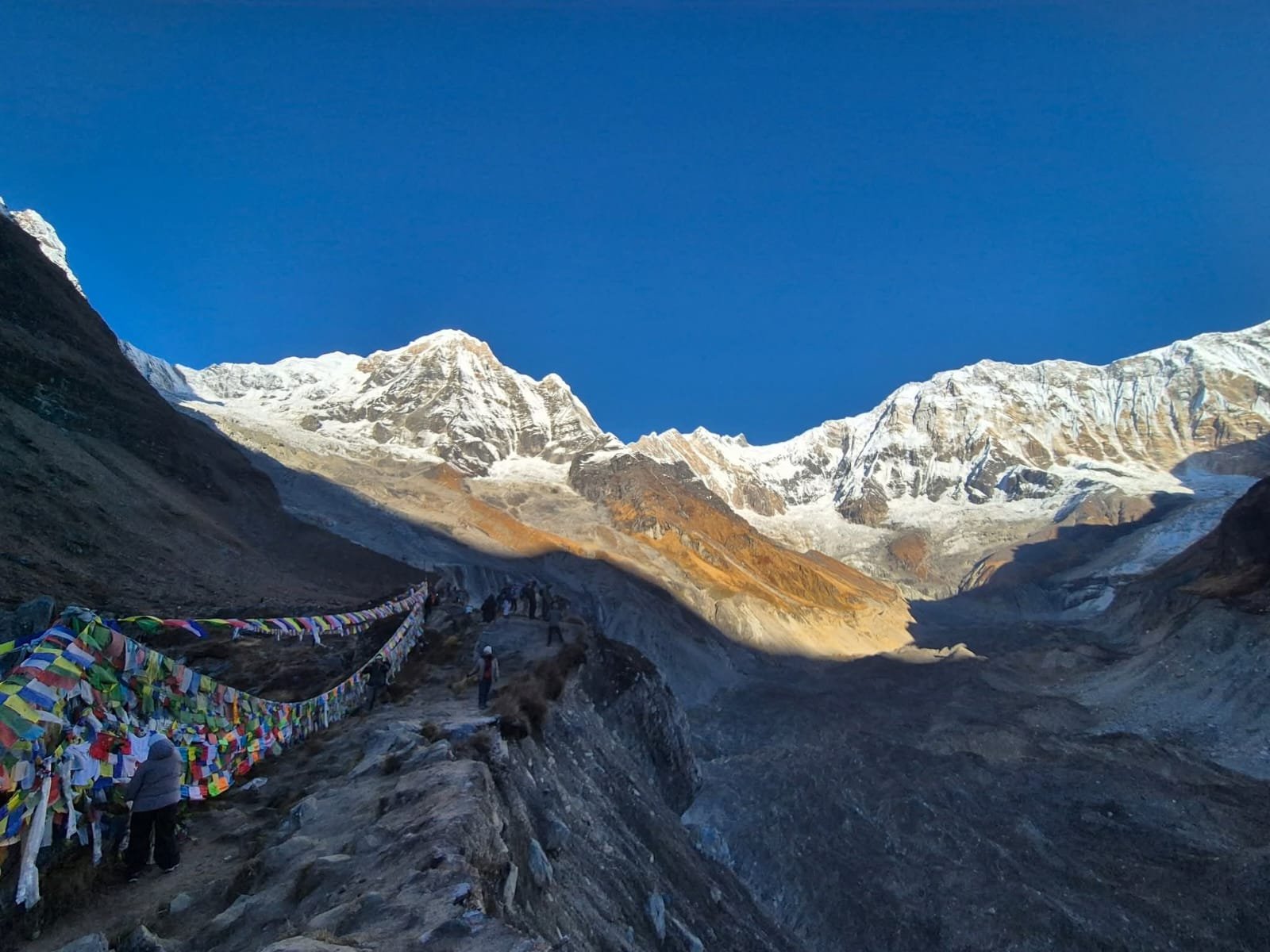
As you approach Annapurna Base Camp, prayer flags come into view, fluttering in the cold mountain wind. The first glimpse of the base camp often triggers an emotional response—relief, excitement, disbelief, and pride all at once. You are standing at the foot of one of the world’s highest and most formidable mountains.
Annapurna Base Camp, located at an altitude of approximately 4,130 meters, sits directly opposite the Annapurna Glacier. The camp is surrounded on all sides by towering peaks, including Annapurna I, Annapurna South, Annapurna III, Gangapurna, Hiunchuli, and the sacred Machhapuchhare. The scale and proximity of these mountains is humbling beyond words.
Standing here, trekkers often fall silent. This is not a place for noise or celebration—it is a place for reflection. Few places on Earth allow non-climbers to come so close to an eight-thousand-meter peak through a trekking route alone.
After arrival, trekkers check into the tea house at Annapurna Base Camp. Once settled, most prefer to rest and conserve energy, as the altitude is at its highest point of the trek. Warm layers are essential, as temperatures remain cold even during the day.
Weather permitting, trekkers may step outside to absorb the 360-degree mountain panorama. Every direction reveals a wall of snow and rock, glowing differently as sunlight shifts. This visual experience is what makes the Annapurna Base Camp Trek legendary.
Dinner is served early at the tea house. Meals are warm and nourishing, helping the body recover from altitude and physical effort. Conversations are often quiet and thoughtful, as trekkers process the magnitude of what they have achieved.
As night falls, Annapurna Base Camp becomes incredibly still. The temperature drops sharply, and the sky often fills with stars. Sleeping at this altitude is challenging for some, but it is also one of the most memorable nights of the trek.
Day 6 is not just the destination day—it is the emotional peak of the trek. Reaching Annapurna Base Camp is a moment that stays with trekkers long after the journey ends. It represents effort, resilience, humility, and connection with the raw power of the Himalayas.
Day 7: Annapurna Base Camp – Bamboo Village
Key Highlights of Day 7
- Early morning views and farewell to Annapurna Base Camp
- Long descent through the Annapurna Sanctuary
- Changing landscapes from alpine terrain to dense forests
- Continuous downhill trekking demanding knee strength
- Re-entry into bamboo and rhododendron forests
- Overnight stay at Bamboo Village
Day 7 of the Annapurna Base Camp Ghandruk Circuit Trek begins early, as trekkers wake up in the heart of the Himalayas at Annapurna Base Camp. If weather permits, the morning offers one last unforgettable view of the surrounding peaks bathed in soft sunrise light. The mountains appear calmer, almost gentler, as if allowing trekkers a quiet farewell.
After breakfast at the tea house, trekkers prepare to leave Annapurna Base Camp and begin the long descent toward Bamboo Village. This day covers a distance of approximately 14 kilometers and can take up to 9 hours to complete. Though the trail leads downhill, it is physically demanding and requires careful pacing.
The initial section retraces the path back through the open alpine terrain toward Machhapuchhare Base Camp. The vast landscape feels different on the return journey. Where anticipation once filled the air, there is now reflection. Trekkers often walk in silence, absorbing the experience they have just lived.
As the descent continues, the trail gradually leaves the stark alpine environment and re-enters the lower zones of the Annapurna Sanctuary. Sparse vegetation slowly transforms into grasses, shrubs, and eventually forest cover. The air feels thicker, and breathing becomes more comfortable with every step down.
Passing through familiar landmarks such as Deurali and Dovan, trekkers begin to feel the return of warmth and greenery. The forests grow denser, and the sound of the Modi Khola returns, echoing through the valley. This change in environment brings a sense of comfort after days spent at high altitude.
The long downhill sections can be challenging on the knees and thighs. Trek leaders encourage controlled steps and frequent short breaks to prevent strain. Trekking poles prove especially useful on this day, providing stability and reducing impact on joints.
Lunch is usually taken at a tea house along the trail, allowing trekkers time to rest, refuel, and rehydrate. A warm meal and hot tea offer renewed energy for the remaining descent toward Bamboo Village.
As trekkers approach Bamboo, dense bamboo and rhododendron forests surround the trail. The soundscape changes from wind and silence to rustling leaves and flowing water. Wildlife sightings, such as birds or monkeys, are occasionally possible in this lush environment.
Arriving at Bamboo Village, located at an altitude of approximately 2,310 meters, feels like a return to familiarity. The village consists of a few tea houses nestled among forested slopes, offering a cozy and peaceful resting place after a long day on the trail.
After checking into the tea house at Bamboo, trekkers are encouraged to rest, stretch, and rehydrate. The warmer air and lower altitude often improve appetite and sleep quality. Dinner is served early, allowing trekkers to relax and recover.
The evening atmosphere in Bamboo is calm and quiet. Conversations are lighter, often filled with laughter and shared memories of reaching Annapurna Base Camp. The sense of accomplishment is strong, as trekkers realize they have completed the most challenging and rewarding part of the journey.
The night is spent in the tea house at Bamboo Village. A good night’s rest here is important, as the trek continues the following day with further descent toward lower villages.
Day 7 represents the transition from achievement to reflection. Leaving Annapurna Base Camp behind does not feel like an ending, but rather the beginning of understanding what the journey has given. The descent offers space to process the experience—physically, mentally, and emotionally—making this day a deeply meaningful part of the trek.
Day 8: Bamboo Village – Chomrong
Key Highlights of Day 8
- Steady ascent back toward Chomrong
- Trek through dense bamboo and rhododendron forests
- Cross suspension bridges over the Modi Khola
- Physically demanding climb with long stone staircases
- Return to familiar villages after days in the sanctuary
- Overnight stay in a tea house at Chomrong
Day 8 of the Annapurna Base Camp Ghandruk Circuit Trek begins at Bamboo Village after a restful night at lower altitude. As the body feels more comfortable with thicker air and warmer temperatures, trekkers prepare for another demanding yet rewarding day on the trail—ascending back toward Chomrong.
After breakfast at the tea house, the trek starts with a gradual walk through dense bamboo forests. The trail is shaded and cool, with sunlight filtering softly through tall bamboo stalks and rhododendron trees. The sound of birds and flowing water creates a calm atmosphere as the day begins.
As the trail progresses, trekkers once again cross suspension bridges over the Modi Khola. These crossings mark the shift from deep forest terrain back toward settled areas. The river below flows swiftly, reminding trekkers of the immense natural forces shaping this landscape.
After crossing the river, the most challenging section of the day begins—the long and continuous ascent toward Chomrong. This climb involves steep stone staircases that demand strong legs, steady breathing, and mental focus. Although the altitude is lower compared to the previous days, the ascent can feel tiring after several days of trekking.
Trek leaders encourage a slow and consistent pace, allowing trekkers to rest briefly at intervals. Hydration and proper breathing play a key role in maintaining energy during this climb. Trekking poles are especially helpful on this section, reducing strain on knees and legs.
As you climb higher, the forest gradually opens up, revealing terraced fields and scattered settlements. These signs of village life bring a sense of familiarity and comfort after days spent deep inside the Annapurna Sanctuary. The return to cultivated land signals the nearing end of the trek.
Lunch is usually taken at a tea house along the route or after reaching Chomrong, depending on the group’s pace. A warm meal provides much-needed energy and an opportunity to relax before completing the final stretch of the day.
Reaching Chomrong once again feels like completing a full circle. Situated at an altitude of approximately 2,170 meters, Chomrong welcomes trekkers with familiar views and a lively village atmosphere. Compared to the remote camps higher up, Chomrong feels vibrant and connected.
Upon arrival, trekkers check into a tea house at Chomrong. After settling in, there is time to rest, freshen up, and enjoy the surroundings. The warmer climate and lower altitude often result in improved appetite and better sleep.
In the evening, trekkers gather for dinner and share reflections from the journey. Conversations often revolve around reaching Annapurna Base Camp, the challenges faced, and the personal moments that made the trek meaningful. There is a strong sense of accomplishment and gratitude.
The trek leader may also discuss the final day’s plan, including the descent to Jhinu Danda and the return drive to Pokhara. With the hardest sections behind, there is a sense of ease and anticipation for the journey’s conclusion.
The night is spent in the tea house at Chomrong. Resting here allows trekkers to recover fully before the final day of the trek and enjoy their last night in the mountains.
Day 8 is a day of resilience and return. It tests physical strength with its long ascent while offering emotional comfort through familiar landscapes and villages. This day bridges the intensity of the high mountains with the calm closure of the trek’s final stage.
Day 9: Chomrong – Jhinu Danda | Drive Back to Pokhara
Key Highlights of Day 9
- Final trekking day of the Annapurna Base Camp Ghandruk Circuit Trek
- Short and scenic descent to Jhinu Danda
- Optional visit to the famous natural hot springs
- Celebration of trek completion
- Comfortable drive back to Pokhara
- Overnight stay in a hotel at Pokhara
Day 9 marks the conclusion of the Annapurna Base Camp Ghandruk Circuit Trek. After breakfast at the tea house in Chomrong, trekkers prepare for the final descent of the journey toward Jhinu Danda. Although the trekking distance is short, the day carries deep emotional significance as it brings the Himalayan journey to a close.
The trail descends gradually through stone-paved paths and forested sections, offering one last opportunity to walk through the landscapes that have become familiar over the past several days. At an altitude of around 1,780 meters, Jhinu Danda lies significantly lower than the high camps, and the air feels warmer and more comfortable.
The trek from Chomrong to Jhinu Danda covers approximately 3 kilometers and takes around 1.5 hours. This gentle walk allows trekkers to move at a relaxed pace, reflecting on the journey and the experiences that shaped it. The physical challenge eases, but the memories feel heavier in the best possible way.
One of the major highlights of Day 9 is the optional visit to the natural hot springs at Jhinu Danda. Located a short walk downhill from the village, these geothermal pools offer the perfect reward after days of continuous trekking. Soaking in the warm water helps relax tired muscles and provides a moment of deep physical and mental release.
After spending time at Jhinu Danda, trekkers gather and prepare for the drive back to Pokhara. The road journey takes approximately 4 hours and covers around 60 kilometers, gradually transitioning from mountain terrain back to city life.
As the vehicle descends through winding mountain roads, rivers, and villages, trekkers witness the changing landscapes one final time. Terraced fields, flowing streams, and rural settlements pass by, serving as a reminder of the journey through the heart of the Annapurna region.
Upon arrival in Pokhara, trekkers check into a comfortable hotel. The contrast between tea house life and hotel comfort feels rewarding after days spent in the mountains. A hot shower, clean clothes, and a soft bed mark the return to modern comforts.
The evening in Pokhara is often filled with celebration and reflection. Trekkers come together for a final meal, sharing stories, laughter, and gratitude. Bonds formed during the trek feel strong, shaped by shared challenges and unforgettable moments.
This evening also marks the official completion of the Annapurna Base Camp Ghandruk Circuit Trek. Trekkers receive appreciation and acknowledgment for their effort, resilience, and commitment throughout the journey.
The night is spent in a hotel at Pokhara, allowing trekkers to rest comfortably after completing the trek. Sleep comes easier, but the mind often lingers on mountain memories.
Day 9 is not just an end—it is a transition. While the trek concludes, the impact of the Himalayas remains. The Annapurna Base Camp journey leaves trekkers stronger, calmer, and deeply connected to the mountains. What begins as a trek often ends as a lifelong memory.
What Is the Difficulty Level of the Annapurna Base Camp Trek?
The Annapurna Base Camp Trek is categorized as a Difficult to Moderately Difficult Himalayan trek, primarily due to its long trekking days, continuous ascents and descents, high altitude exposure, and rapidly changing mountain weather. While the trail does not involve technical climbing, it demands strong physical endurance, mental resilience, and proper preparation.
This trek is not recommended for absolute first-time trekkers unless they have excellent fitness levels and prior experience with long-distance hiking. The journey takes you to an altitude of 4,130 meters at Annapurna Base Camp, where oxygen levels are significantly lower, making proper acclimatization a critical factor.
Why the Annapurna Base Camp Trek Is Considered Difficult
High Altitude and Acclimatization Challenges
One of the main reasons the Annapurna Base Camp Trek difficulty is rated high is altitude. As you gain elevation, oxygen levels drop, and the body must adapt gradually. Without proper acclimatization, trekkers may experience symptoms of altitude sickness such as headache, fatigue, or nausea.
The Annapurna Base Camp Ghandruk Circuit route helps with gradual altitude gain, but trekkers must still follow a disciplined pace, hydrate well, and listen to their bodies at all times.
Long and Demanding Trekking Days
Trekkers can expect daily walking hours ranging from 6 to 9 hours, often involving steep stone staircases, forest trails, and uneven terrain. Some days require continuous ascents followed by steep descents, which can be physically exhausting, especially for knees and legs.
This continuous physical effort over multiple days is what makes the trek challenging even for physically fit trekkers.
Sub-Zero Temperatures at Higher Camps
At higher altitudes such as Machhapuchhare Base Camp and Annapurna Base Camp, temperatures can drop below freezing, especially during early mornings and nights. Proper cold-weather gear, layered clothing, gloves, and thermal wear are essential to stay warm and safe.
Inadequate clothing can quickly turn discomfort into a serious safety risk in the Himalayas.
Footwear: The Most Critical Gear
Good trekking shoes are non-negotiable for the Annapurna Base Camp Trek. The trail includes stone steps, muddy sections, snow patches (in colder months), and rocky paths.
A well-broken-in, high-ankle trekking shoe with excellent grip can prevent injuries, slips, and blisters. Poor footwear is one of the most common reasons trekkers struggle or fail to complete the trek.
Weather and Seasonal Risks
The best time to do the Annapurna Base Camp Trek is post-monsoon (September to November) and pre-monsoon (March to May). During the monsoon season, heavy rainfall increases the risk of landslides, slippery trails, and leeches.
Weather in the Himalayas can change rapidly, so trekkers must be prepared for cold winds, sudden snowfall, or rain—even in peak seasons.
Limited Connectivity and Mental Preparedness
Mobile phone networks do not function reliably along most sections of the trek. This isolation is part of the Himalayan experience, but it also means trekkers must be mentally prepared to disconnect from the outside world.
Limited connectivity requires trekkers to rely on their group, guides, and inner strength, making mental readiness just as important as physical fitness.
Physical Preparation Required for the Trek
To comfortably complete the Annapurna Base Camp Trek, trekkers should begin preparation at least 6–8 weeks in advance. Recommended training includes:
- Regular brisk walking or jogging
- Stair climbing with a loaded backpack
- Strength training for legs and core
- Basic endurance and cardio workouts
Carrying a backpack weighing 10–12 kg over long distances can significantly impact energy levels, so learning to travel light is highly recommended.
Importance of Buffer Days and Safety Planning
Weather delays are common in the Himalayas. Keeping an extra buffer day in your itinerary is highly advisable to manage bad weather, trail conditions, or health-related delays.
Good planning is the difference between a safe trek and a stressful one.
Why Choosing Himalayan Hikers Makes This Trek Safer
The difficulty of the Annapurna Base Camp Trek increases significantly without experienced support. Choosing a professional trekking company plays a crucial role in trek success.
Himalayan Hikers brings years of high-altitude trekking experience, trained guides, and strong local networks to ensure:
- Proper acclimatization schedules
- Safe pacing and route planning
- Continuous health monitoring
- Emergency preparedness
- Our mission is safe trekking experiences while supporting the growth and livelihood of local communities.
Recommended Trekking Seasons for Annapurna Base Camp Ghandruk Circuit
The Annapurna Base Camp Ghandruk Circuit Trek is best experienced during the pre-monsoon (spring) and post-monsoon (autumn) seasons. During these periods, weather conditions are stable, trails are safe, and the Himalayan views are at their most spectacular. Choosing the right season is essential for a safe and enjoyable high-altitude trekking experience.
Spring Season (March to May)
Spring is one of the most popular seasons for the Annapurna Base Camp Trek. The trail comes alive with blooming rhododendron forests, lush greenery, and pleasant temperatures, making it ideal for nature lovers and photographers.
- Stable weather and comfortable daytime temperatures
- Blooming rhododendron and vibrant forest landscapes
- Clear views of Annapurna Range, Machhapuchhare, Hiunchuli, and Annapurna South
- Excellent conditions for photography
Autumn Season (September to November)
Autumn is considered the best and most reliable time to do the Annapurna Base Camp Ghandruk Circuit Trek. After the monsoon rains, the skies are crystal clear and mountain visibility is at its peak.
- Dry trails and minimal rainfall
- Crisp air with breathtaking panoramic mountain views
- Stable weather suitable for long trekking days
- Best season for first-time Himalayan trekkers
Winter Season (December to February)
Winter trekking to Annapurna Base Camp is possible but recommended only for experienced trekkers. Temperatures drop significantly at higher altitudes, and proper winter gear is essential.
- Very cold temperatures, especially at Machhapuchhare Base Camp and Annapurna Base Camp
- Snow-covered landscapes and quieter trails
- Requires advanced preparation and cold-weather equipment
Monsoon Season (June to August) – Not Recommended
The monsoon season is generally not suitable for the Annapurna Base Camp Trek due to heavy rainfall and increased risk of landslides.
- Frequent rainfall and slippery trails
- Higher chances of landslides in certain sections
- Limited mountain views due to cloud cover
Best Season Recommendation
At Himalayan Hikers, we strongly recommend planning the Annapurna Base Camp Ghandruk Circuit Trek during spring (March–May) or autumn (September–December). These seasons offer the best balance of safety, visibility, and overall trekking comfort.
Route and Access to Annapurna Base Camp Ghandruk Circuit Trek
The Annapurna Base Camp Ghandruk Circuit Trek starts from Pokhara, which is well-connected to major cities in Nepal. Reaching Pokhara is easy and convenient by road or air, making this trek one of the most accessible high-altitude treks in the Himalayas.
Reach Pokhara from Kathmandu
Kathmandu, the capital of Nepal, is the main international entry point. From Kathmandu, you can reach Pokhara using the following options:
- By Flight: A domestic flight from Kathmandu to Pokhara takes approximately 25–30 minutes and offers stunning aerial views of the Himalayan range.
- By Road: Tourist buses and private vehicles take around 5–6 hours to reach Pokhara via scenic mountain highways.
Pokhara to Ghandruk (Trek Starting Point)
From Pokhara, the journey continues towards Ghandruk, the cultural gateway of the Annapurna Base Camp Ghandruk Circuit Trek.
- Drive: A road journey of approximately 4 hours takes you from Pokhara to the Ghandruk bus stand.
- Trek: From the roadhead, a short trek leads to Ghandruk village, located at an altitude of 2,013 meters.
Return Journey
The trek concludes near Jhinu Danda, from where trekkers drive back to Pokhara. From Pokhara, onward travel to Kathmandu or other destinations can be planned by road or flight.
Travel Support by Himalayan Hikers
At Himalayan Hikers, we assist trekkers with complete travel planning, including transportation coordination from Kathmandu to Pokhara and local transfers to the trek starting point. Our goal is to ensure a smooth, stress-free journey from arrival to trek completion.

Necessary Items for trekkers
Mandatory Documents
Original and photocopy of government photo identity card- (Aadhar Card, Driving License, Voters ID, etc,)
Passport and Visa important to foreigners
Medical Certificate (First part should be filled by the Doctor and Second part by the Trekker)
Declaration Certificates
Note: – Many trekkers commit the same mistake of carrying unnecessary items on a trek which only makes the backpack heavy. It is important to know the right items to carry. It differs from season to season if you are trekking in summers then carry less layers of warm clothing and if you are trekking in winters carry enough layers to protect yourself against chilly cold.
Basic Trekking Gears

The Clothes You Should Bring On Satopanth Expedition

Head Gears

Foot Gears

Personal Care Essentials

Carry a Personal Medical Kit

Are you Looking for Trekking Equipment on Rent?
If any trekker requires trekking equipment on rent, Himalayan Hikers offers the best-quality gear available for rental. Many individuals are in need of such equipment, and renting provides a cost-effective solution, allowing them to access high-quality gear at an affordable price without the need for a significant investment for short-term use.

Trek Equipment You can book directly on first day at the Base Camp.
Note:-
Please take all medicines only when prescribed by the doctor. In case you face any problem during your trek,
discuss and take advice from the Professional guide.
The Trek is one of the most popular treks in Uttarakhand, Himachal,Kashmir,Laddakh,Sikkim,Nepal, requiring both physical preparation and mental readiness. Although it is categorized as a moderate trek, reaches an elevation of over 12,720 feet and traverses remote Himalayan terrain, which can be physically and mentally challenging. Here's how you can prepare yourself for a safe and successful accomplishment of the Trek:
Physical Fitness
Building a good fitness base is essential for every trekker. The Trek itinerary involves 5 to 6 hours of walking every day. Though the trails are well-marked, they are often bumpy and include steep uphill sections, which may affect your stamina. You can overcome your physical limitation with a 6-week training program that you can begin about 2 months before your Trek. Your 6-week fitness routine should include

Pro Tip: If you have time, you can skip the Sunday training and go for a long-distance walk or mini day-hike (7–10 km) with a loaded backpack to simulate real trekking conditions. A short 1-day hike around your city/town can help a lot.
Mental Preparation
Physical strength is only half the journey, the other half is mental resilience. The trail takes you through remote clearings, steep climbs, cold starry nights, and no mobile connectivity. Be prepared to:
(I) - Detach from the digital world.
(II) - Embrace basic mountain living (camping, toilet tents, limited electricity).
(III) - Push through moments of fatigue, weather discomfort, or altitude effects.
A positive mindset, patience, and the ability to adapt will carry you farther than muscle ever could.Himalayan Hikers is a reputable trekking company that places a high priority on safety. Here are some of the safety measures they take to ensure the safety of their clients during the Trek:
Experienced Guides: Himalayan Hikers hires experienced and certified guides who are well-versed in the terrain, weather conditions, and local culture. These guides have first-hand knowledge of the routes and are equipped to handle any emergency situations that may arise.
Proper Gear: The company provides all the necessary gear and equipment to their clients to ensure comfort and safety during the trek.
Hygiene and Sanitation: Himalayan Hikers places great emphasis on hygiene and sanitation during the Trek. They provide clean drinking water, hand sanitizers, and toilet tents to ensure that their clients are healthy and comfortable.
Emergency Services: The company has a well-defined protocol for handling emergency situations. They have a team of trained medical professionals who are available 24/7 and can be quickly mobilized in case of an emergency.
Acclimatization: Himalayan Hikers follows a gradual acclimatization process during treks to ensure that their clients adjust to the high altitude gradually. They also monitor the health of their clients regularly and provide necessary medical attention if required.
Overall, Himalayan Hikers places a great emphasis on safety and takes all necessary measures to ensure the safety and well-being of their clients during treks.
| Accommodation |
Day 1 & Day 9 stay in a hotel at Pokhara. Day 2 to Day 8 accommodation in tea houses during the trek. |
|---|---|
| Meals | Vegetarian & Non-Vegetarian meals from Day 1 Dinner to Day 9 Dinner. |
| Permits | ACAP (Annapurna Conservation Area Permit). |
| Transportation | Pokhara to Ghandruk and Jhinu Danda to Pokhara by car. |
| Medical Support | First aid medical kit, oxygen can, and oximeter for altitude monitoring. |
| Safety Equipment | Micro spikes and gaiters (provided as per snow conditions). |
| Group Leader | Experienced trek leader, certified guide, and supporting staff. |
| Additional Services | Cloakroom facility at Pokhara for extra luggage storage. |
| Certificate | Trek Completion Certificate. |
| Insurance | Personal travel insurance is mandatory. No trek permit will be issued without valid insurance. |
|---|---|
| Personal Expenses | Any kind of personal expenses such as shopping, tips, laundry, phone charging, etc. |
| Transit Meals | Meals during travel or transit are not included. |
| Offloading Charges |
₹5,000 INR per backpack (up to 7 kg)
for the entire trek. ₹7,500 INR per backpack (up to 10 kg) for the entire trek. |
| Transport from Raxaul | ₹3,000 INR – Raxaul to Pokhara and Pokhara to Raxaul. |
| Emergency Costs | Emergency evacuation, rescue, and hospitalization charges. |
Important Note
Note: You must carry your original Voter and Aadhaar cards with you when traveling Annapurna Basecamp Ghandruk Circuit. Any additional expense arising from various / unforeseen circumstance:
Note 1: In the event that an extra day is required for the trekking itinerary due to unforeseen weather conditions, government orders, socio political unrest, self-injury or any others illness during trek. Additional cost of ₹2500/- (Two Thousand Five Hundred Indian Rupees) per day will be incurred. This cost must be paid by the trekkers.
Note 2: In case any Trekker is injured or medically not fit to carry out the Trek, He or She has to descend. We could be arranged for the same however the Trekkers have to bear the expenses for the descend or discontinue. The same is applicable for someone wiling not to continue the Trek.
Map not available for this trek.
The trek usually takes 9 days, including travel and acclimatization.
The highest point is Annapurna Base Camp at 4,130 meters.
This trek is not recommended for first-time trekkers without good fitness and preparation.
The trek starts and ends at Pokhara, Nepal.
The best time is March–May and September–December.
Accommodation is in tea houses and a hotel in Pokhara.
Both vegetarian and non-vegetarian meals are provided throughout the trek.
Yes, the ACAP (Annapurna Conservation Area Permit) is mandatory.
It is a moderate to difficult Himalayan trek.
Yes, proper acclimatization and hydration are essential to avoid altitude sickness.
Mobile network is limited and unreliable along most sections of the trek.
Himalayan Hikers ensures experienced guides, safety, and responsible trekking practices.


